Inside the D.C. National Guard Ambush: Army Service Member Sarah Beckstrom, 20, Tragically Falls, While Air Force Sergeant Andrew Wolfe, 24, Fights for His Life — New Insights Emerge About Her Final Minutes — Doctors Report an “Unexplained Moment” in the ER — And a Reconstructed Timeline Has Left Investigators Searching for Answers

A City on Edge: The Night That Changed Everything
Washington, D.C. has known turbulent nights, moments of tension, and rare flashes of unexpected danger — but few incidents in recent memory have left as deep an emotional mark as the ambush involving two young members of the National Guard:
20-year-old Army service member Sarah Beckstrom and 24-year-old Air Force Sergeant Andrew Wolfe.
In the hours leading up to the shooting, the city’s rhythm seemed normal. Traffic lights changed in predictable cycles, office workers poured out of the downtown district, and the crisp night air carried the distant echo of sirens — routine in a capital city that never truly sleeps.
No one could have predicted that within minutes, two young service members would be thrust into a life-or-death emergency that would ripple through military communities, their families, and the public for days afterward.
When the first 911 calls came in, dispatchers reportedly heard a mixture of panic, urgency, and the unmistakable tone of witnesses describing something they had never expected to see. The word “ambush” was mentioned more than once, though early reports remained cautious, noting that investigations were ongoing and no conclusions could be drawn.
But something in the descriptions — the urgency, the fear, the raw emotion — made the night unforgettable for everyone who witnessed it.

Who Was Sarah Beckstrom? A Portrait of a Young Soldier
Before the tragedy, before headlines mentioned her name, before the incident became a symbol of fragility and courage, Sarah Beckstrom was simply Sarah — a young woman from West Virginia, a daughter, a friend, a newly enlisted member of the National Guard who had begun her service in June 2023.
Those who knew her described her as:
-
Quiet but sharp
-
Disciplined yet warm
-
Focused, determined, and unusually mature for her age
-
A young woman who took service seriously, even before understanding what it might one day demand
Her father had once said that Sarah “lived like someone who understood responsibility early,” a sentiment he repeated in several emotional interviews after her passing. He didn’t say it to elevate her above others, nor to create a heroic narrative. He said it because, in his words, “
May you like



That’s who she was. She wanted to make a difference, even if it was small.”
Sarah had passed her training with high marks. She was known for her ability to stay calm under pressure, a quality that surprised her instructors during the first few months. She rarely boasted, never competed for attention, and often helped new recruits adjust to the demanding environment.
Off duty, she enjoyed hiking, digital art, and visiting her younger cousins, who adored her. She kept her private life remarkably private — so much so that her closest friends later admitted they never fully understood the extent of her stress levels during the days leading up to the shooting.
Her messages, revealed only after the tragedy, suggested she may have been feeling overwhelmed — not by danger, but by the weight of responsibility, sudden changes in routine, and what she described simply as “
too much happening at once.”
Nothing in her communication implied she anticipated violence or believed she was in direct danger. But the emotional undertones raised questions later analyzed by investigators, counselors, and her family.

Andrew Wolfe: The Airman Fighting for His Life
At 24, Air Force Sergeant Andrew Wolfe had already established himself as someone committed to service. Slightly older than Sarah, he often served as an informal mentor to younger Guard members and newer recruits.
Those close to him described him as:
-
Steady and reliable
-
The type of person who remained calm even when others panicked
-
Someone who valued structure and purpose
-
A natural “older brother” figure to many in the service
Andrew had been through more advanced training than Sarah, but he never treated her as anything less than an equal. Their working relationship was respectful, friendly, and professional. They were not close friends, but they were connected in the way service members often are: through shared spaces, shared duties, and shared expectations.
The night of the shooting, Andrew reacted quickly — details confirmed by witnesses, though exact sequences remain under review. His efforts to protect himself and respond appropriately were noted by several individuals who saw the aftermath.
Today, Andrew’s condition remains critical but stable. His family has shared only limited information, asking for privacy but expressing deep gratitude for the widespread support.
The Final Hours Before the Shooting
Reconstructing the timeline has required investigators to review witness accounts, digital communications, environmental conditions, and hour-by-hour movements. While many questions remain, a broad outline has begun to take shape.
6:45 PM — Routine Tasks
Both Sarah and Andrew reportedly completed routine administrative tasks earlier in the evening. There was nothing unusual in their actions or communications.
7:10 PM — Communication with Family
Sarah sent a brief message to her father — nothing alarming, only a short update and a casual comment about the weather. Her father later described the message as “
completely normal.”
8:00 PM — A Slight Shift in Behavior
One colleague later noted that Sarah appeared “a little quieter than usual,” but also said it was not enough to indicate anything out of the ordinary.
8:22 PM — The Moment Before
According to witness statements, Sarah and Andrew were near a government building when the shooting occurred. Exact positioning remains under analysis, but both were outside and visible.
8:24 PM — Emergency Calls Begin
Multiple 911 calls were made within seconds of each other. The descriptions were urgent but varied; some witnesses saw only the aftermath, while others saw the first moments of confusion.
8:33 PM — First Responders Arrive
Paramedics and officers reached the scene quickly. Sarah was immediately transported to the hospital. Andrew was rushed into emergency surgery shortly after arrival.
The Emergency Room: What Doctors Described as “Unexplained”
ER staff members, speaking carefully and without speculation, later commented on what they described as an “unexplained moment” during the initial treatment phase.
The phrase has circulated widely, though doctors clarified that the term referred to a
medical observation that did not immediately match expectations, not a supernatural or sensational event.
According to hospital statements:
-
The exact nature of Sarah’s response to treatment was unusual.
-
This type of response is rare but not unheard of.
-
The “unexplained” element referred to timing, not impossibility.
-
Medical staff considered it meaningful enough to report for documentation.
The hospital later emphasized that unusual medical responses can occur in extreme trauma cases, and no definitive conclusions should be drawn from that single moment.
Still, for those present, the experience was emotional and unforgettable — a stark reminder of the unpredictability of trauma medicine.

Investigators Examine the Timeline
As the investigation progressed, analysts reconstructed a detailed timeline of the events. One particular element drew attention:
A Two-Minute Window That Raised Serious Questions
Within the reconstructed timeline, a two-minute gap contained limited witness clarity and incomplete audio from nearby surveillance. While there is no evidence of wrongdoing beyond the shooting itself, the gap prompted investigators to examine:
-
Ambient noise levels
-
Environmental obstructions
-
Witness angles
-
Vehicle movement in the vicinity
-
Possible delayed recognition of the first shot
-
Potential technical issues with audio capture
This gap does not imply conspiracy or hidden actions — but it has required additional review simply because trauma events often unfold rapidly, making sequences harder to reconstruct with absolute precision.
Investigators have stated repeatedly:
-
There is no suggestion of intentional suppression or manipulation.
-
No conclusions have been drawn regarding the cause of the gap.
-
Such gaps are common in chaotic, outdoor emergency situations.
But the emotional weight of the event — and the loss of a young soldier — has made every second feel significant.

The Community Response: Vigils, Ribbons, and Support
Within hours of the news breaking, communities across West Virginia and beyond began honoring both service members.
Blue Ribbons Everywhere
Neighbors tied blue ribbons to fences, porches, and car antennas.
A Poster Filled With Messages
In Webster Springs, a large poster board bearing Sarah’s name quickly became a canvas for hundreds of handwritten notes.
Prayer Vigils
Churches held special gatherings. Fellow service members organized small circles of remembrance. Families who had never met the Beckstroms or Wolfes lit candles at home.
Online Support
Thousands shared prayers, well wishes, and condolences — careful to avoid making assumptions about the ongoing investigation, but united in emotional support.
Sarah’s Father Speaks: A Family Navigating Unimaginable Grief
When Sarah’s father addressed the public, his voice was steady but deeply emotional. He did not blame anyone, did not express anger, and did not offer speculation. Instead, he spoke of:
-
Who Sarah was
-
How proud he was of her
-
The heartbreak of receiving the news
-
His hope that Andrew recovers fully
One moment in his statement resonated widely:
“She gave everything she had, every day — not because she expected reward, but because she believed in service.”
His later comment, acknowledging the severity of her injuries, was raw and heavy, but he phrased it responsibly:
“We were told the injuries were extremely severe. We knew her chances were low, but we held on to hope. We’re grateful for every person who tried to save her.”
The dignity in his words moved thousands.
The Wolfes’ Family Statement: Hope in the Face of Uncertainty
While Andrew remained in critical condition, his family released a short message:
“Andrew is fighting. We are grateful beyond words for the support, prayers, and kindness shown to us. We ask for privacy as he continues his recovery.”
Friends of the Wolfe family organized donation drives and meal deliveries, ensuring the family could focus solely on Andrew’s care.
Experts Weigh In: Trauma, Confusion, and Human Response
Medical professionals, security analysts, and military counselors later offered general insight — not specific to the case, but helpful in understanding its context.
Trauma Experts
Noted that unpredictable medical responses are possible in extreme cases.
Military Counselors
Explained that rapid emotional shifts in service members may not indicate danger but can reflect stress, fatigue, or personal challenges.
Forensic Analysts
Clarified that timeline inconsistencies are common in sudden, chaotic events, especially outdoor ones.
Nothing in the expert commentary suggested wrongdoing, conspiracy, or negligence — only the complexity of real-world emergency situations.
The Growing Cultural Impact: A Story That Resonates Nationwide
The incident has sparked conversations about:
-
The daily experiences of National Guard members
-
The pressures young service members face
-
The unpredictable nature of urban risks
-
The importance of community support
-
The emotional toll of sudden tragedy
Though the public reaction has been strong, most discussion has remained thoughtful and respectful.
What Happens Next: The Path Forward
The investigation is ongoing, and authorities continue to emphasize:
-
No final conclusions have been drawn.
-
Evidence collection is still in progress.
-
Community patience is appreciated.
Meanwhile, both families continue receiving support from across the country, reminding them they are not alone in their grief and fear.
A Legacy of Service and Strength
Though young, Sarah left behind a legacy defined not by the tragedy of her final moments, but by:
-
Her commitment
-
Her kindness
-
Her dedication
-
Her quiet strength
Andrew’s story remains unfinished. With each day, his community hopes for progress, healing, and recovery.
The Questions That Remain — And Why They Matter
As investigators review evidence, several questions continue to guide their work:
What occurred during the two-minute gap in the timeline?
What environmental factors may have influenced visibility and response time?
What exactly did ER doctors observe — and how common is such a response?
How did the sequence of events unfold from the perspective of each witness?
What can be learned to improve safety and response protocols in the future?
None of these questions imply wrongdoing. They reflect the desire to understand a complex and heartbreaking event more clearly.
Remembering the Human Story Behind the Headlines
Behind the headlines, behind the statements, behind the analysis, this is ultimately a human story — one of service, loss, resilience, fear, and hope.
It is the story of:
-
A young woman who served with quiet dedication
-
A young airman fighting for his life
-
Families navigating unthinkable pain
-
A community coming together
-
Investigators seeking clarity
-
A nation pausing to reflect
And though answers may take time, the emotional truth is already clear: their stories matter.
Conclusion: A Night That Will Be Remembered
The D.C. ambush will be remembered not only for its tragedy but for the unity that followed, the compassion shown, and the questions raised about how fragile and precious every moment truly is.
As more details emerge, the hope is that understanding will bring healing — for the families, for the community, and for everyone touched by Sarah and Andrew’s story.
For now, the nation waits, watches, and remembers.
“HER LOGO IS EVERYWHERE. MINE’S IN THE CLEARANCE BIN.”

“HER LOGO IS EVERYWHERE. MINE’S IN THE CLEARANCE BIN.”
Angel Reese FROZE When She Saw Caitlin Clark’s New Nike Merch — And the Room Went Dead Silent.
The first question wasn’t even about her.
The Indiana Fever media room was colder than usual that afternoon — not by temperature, but by tone. Angel Reese sat down in front of a dozen reporters, tying her hoodie strings a little too tight, as if to shield herself from whatever headline was waiting to be written. A few questions came and went — game plans, rebounds, rotations. She gave short answers. Nodded. Blinked. The usual.
Then someone asked, “Have you seen Caitlin Clark’s new logo yet?”
She froze.
That wasn’t the question she came here for. That wasn’t the conversation she wanted to have. But it was the only conversation happening in the world of women’s basketball at that very moment — because Caitlin Clark’s Nike debut line had just detonated like a branding nuclear bomb.
And Angel Reese — for the first time in her Reebok-backed, spotlight-saturated, influencer-driven journey — had no spotlight left to stand in.
She blinked once. Looked straight ahead. Then leaned into the mic and said five words:
“Guess who’s still on sale.”
The room went dead silent.
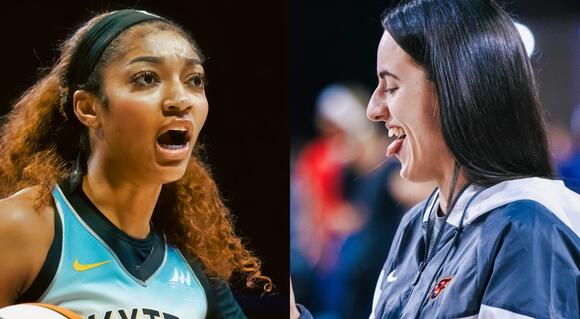
And in that second, a shift happened — not just between Clark and Reese, but across the entire architecture of sports marketing. Because those five words didn’t just sound like a jab. They sounded like resignation.
They sounded like defeat.
And they were caught on camera.
Caitlin Clark’s Nike launch wasn’t supposed to dominate the news cycle for more than a day. That’s how most women’s apparel drops work: trending for 24 hours, a few tweets, a highlight reel, then back to business.
But this one was different.
It dropped at midnight on September 1, during the kickoff of Nike Women’s Fall 2025, an annual showcase that typically featured Serena Williams, Simone Biles, or Megan Rapinoe. But this time, the entire event revolved around a 23-year-old rookie from Iowa.
The logo? Two overlapping C’s, stylized like wings, embedded into a minimalist silhouette of a three-point shot. The colors were bold. The tagline was bolder: “Distance Isn’t a Limit. It’s a Weapon.”
And then… everything exploded.
Within six minutes, the website sold out of all hoodies and crop tops in five states.
Within an hour, Nike stores in Chicago, Indianapolis, and Houston had lines around the block.
By 8 AM, celebrities like Zendaya, Chloe Bailey, and even WNBA legends like Sue Bird were posting unboxings on Instagram.
And by noon, the phrase #ClarkEffect was trending across Twitter, TikTok, and ESPN’s front page.
Meanwhile, across town, Reebok had quietly restocked Angel Reese’s summer collab line… and nothing moved.
No posts.
No sellouts.
No lines.
No spotlight.
And Angel Reese felt every second of it.
“She left practice early. That’s all I’m gonna say.”

The quote came from a Fever teammate who spoke anonymously to a reporter from The Athletic just hours after the Nike line dropped. She described the mood inside the gym as “off,” noting that Reese barely made eye contact, didn’t stay for team film, and skipped her usual post-practice stretching.
At first, it seemed like nerves — maybe exhaustion. But then came the silence.
No tweets from Reese.
No Instagram Story.
No friendly “Congrats, Caitlin.”
Just radio silence.
And in today’s WNBA ecosystem — where visibility is currency — silence is a statement.
Behind the scenes, Reebok staffers were reportedly scrambling. Internal Slack messages leaked on Reddit showed marketing team members questioning why sales hadn’t spiked as expected, despite a renewed ad push the day before. One message read:
“We’ve spent $60k in influencer promo this week and barely cracked 800 units. Do we need to pivot again?”
Meanwhile, Nike was preparing a pop-up activation event in downtown Des Moines. Clark wouldn’t even be there — but they didn’t need her.
She had already become a movement.
It wasn’t the words themselves. It was how she said them.
At the press conference that afternoon, Reese didn’t roll her eyes. She didn’t laugh. She didn’t smirk like she had in LSU days. When she said “Guess who’s still on sale”, it wasn’t sassy — it was subdued. Quiet. Controlled.
Like she knew the cameras were rolling.
Like she had rehearsed it.
Like she wanted it to hurt.
And it did.
Within 45 minutes, the clip hit Twitter.
Within two hours, it had 3.4 million views.
By dinner, ESPN ran it as a B-segment on Outside the Lines with the caption:
“Reese Responds: Frustration or Foreshadowing?”
TikTok commentators broke down the microexpressions.
YouTubers made reaction videos.
Podcasters on both sides of the cultural divide started dissecting the branding war now fully underway.
On one side: Caitlin Clark, Nike’s silent storm. The girl-next-door who never said anything controversial — but whose every release sent shockwaves.
On the other: Angel Reese, loud, proud, and now suddenly… quiet.
The reversal of energy was stunning. For two years, Reese had been the face of provocation — chest-pounding, finger-pointing, viral-celebrating confidence. But now, when it was time to reassert that dominance, she looked tired.
The silence wasn’t part of the plan.
By Sunday morning, Reebok pulled her homepage.
No announcement. No context. Just replaced with a back-to-school ad featuring general training gear — no mention of Reese’s line at all.
That same day, sports marketing columnist Jada Billingsley published a brutal headline on AdWeek:
“When Silence Speaks Louder: How Reebok Lost the Angel Reese Moment”
In it, she wrote:
“Brand loyalty is about belief — in story, in impact, in presence. Clark didn’t just drop merch. She dropped proof of concept. Reese dropped off the map.”
At the same time, Nike insiders were leaking that Clark’s line had outsold any WNBA-related launch in company history. And it wasn’t just hype — data from StockX showed resale prices of Clark hoodies tripled overnight.
Meanwhile, retailers still had Reese’s gear sitting at 40% off.
One D.C. fan posted a now-viral photo from a Reebok store:
“Whole wall of Reese. Nobody buying. Manager says they haven’t restocked since July.”
Inside Reebok’s Boston HQ, things turned chaotic.
An internal email from a senior brand manager was leaked to Front Office Sports:
“We cannot spin this. We’ve lost control of the narrative. Every move we make now will look reactive.”
Another staffer reportedly requested to move off the Reese account, writing in Slack:
“There’s no way to protect this. I warned we shouldn’t tie a 3-year brand plan to someone whose biggest asset was controversy.”
Some even floated shifting their WNBA investment to a newer rookie. One name mentioned: Rickea Jackson.
But it was too late. The public had picked a side — and it wasn’t the one with clearance tags.
Online, the backlash had split into two warring camps.
On Reddit’s r/WNBA thread, a post titled “Clark’s Merch Sold Out in 6 States — Meanwhile…” showed a side-by-side image: Clark’s empty display wall next to Reese’s fully stocked shelf. The top comment read:
“She pointed fingers in college. Now fans are pointing them back.”
Instagram accounts with names like @clarknation and @reebesupremacy fired daily memes at each other.
Twitter users dissected interview tones.
Threads got so toxic that moderators began disabling comments.
But the loudest voices came from podcasts.
On The Timeout Table, a popular WNBA culture pod, co-hosts Mariah Ellis and Josh Delmar debated the viral moment for 40 minutes.
Josh: “Angel built her brand on being loud. Now that silence is here, it feels… off-brand.”
Mariah: “Or maybe it’s not off-brand. Maybe it’s growth. Maybe she’s tired of fighting a system that never gave her the same leeway.”
The debate sparked firestorms on both sides.
But one thing was clear: everyone was talking about it.
Back inside the Fever locker room, the silence lingered.
Reporters were told Reese wouldn’t be available after practice “due to recovery.”
Head coach Stephanie White dodged two questions about “brand distractions,” simply saying, “We’re focused on basketball.”
But teammates noticed something different.
“She’s not talking in the huddles anymore,” one player told Bleacher Report. “She used to be the loudest voice. Now she’s just… watching.”
It’s unclear whether Reese is being advised to stay silent or choosing it herself. But for someone who built an entire image on unapologetic volume, the absence of noise feels louder than anything.
And fans feel it too.
The same Instagram post that announced Clark’s Nike line — 1.6 million likes.
Reese’s last post? A promo for her Reebok shorts. Comments turned off.
So what now?
Industry insiders say Reebok may be reconsidering its entire partnership model. One anonymous exec told Forbes:
“We thought we had Gen Z in the bag with Reese. But visibility doesn’t always translate into conversions. This launch from Nike changed the stakes.”
There’s speculation Clark may now receive her own WNBA signature shoe — something no player has had since Diana Taurasi.
Meanwhile, Angel Reese’s five words are still echoing across every sports debate panel, every comment thread, every podcast title.
Some say she was throwing shade.
Some say she was hurt.
Some say she was warning us — that she’s not done yet.
But one thing’s certain:
Her logo may still be on shelves. But her silence is what sold the story.
Certain elements in this article are based on publicly available reports, third-party commentary, and ongoing cultural discussions at the time of publication. Some names, sequences, and interpretations have been adapted to reflect the broader landscape of media narratives in sports branding. No official statements from the companies or individuals involved have been confirmed at press time.